DAC technology siting and performance assessment using NECTAR, the Negative CO2
Emission Transition Roadmap.
Optimizing site selection and design for DAC technology
Using proprietary NECTAR software and its comprehensive supporting database, Carbon Solutions identifies optimal sites for DAC deployment. This includes evaluating technology performance based on hourly climate, elevation, CO2 storage potential, renewable energy availability, and other critical factors. In addition to site suitability, NECTAR analyzes resource use, including water consumption and energy demand, ensuring that sites are not only technically feasible but also resource-efficient. NECTAR is designed to maximize CO2 capture efficie
storage potential, renewable energy and power availability, and other factors. NECTAR aims to maximize CO2
capture while minimizing energy needs and costs.
Our Process
Novel approach to DAC siting and assessment
DAC technology performance
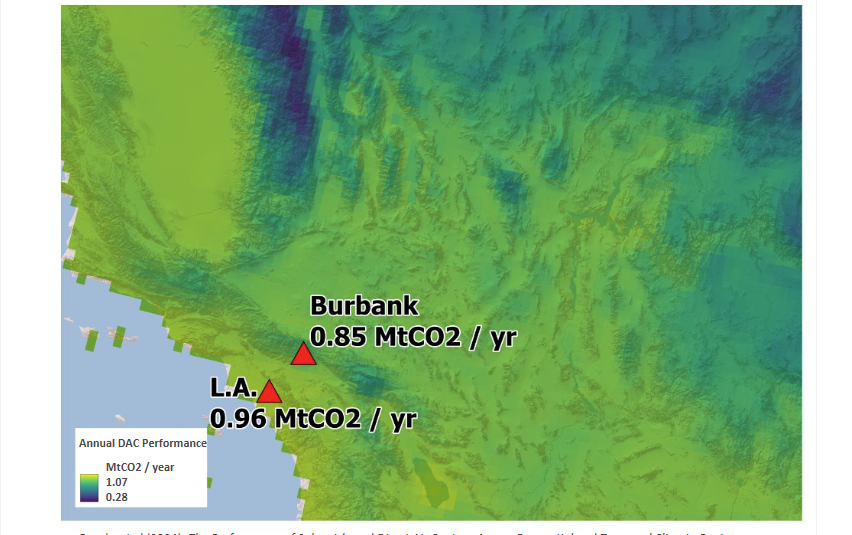
NECTAR tailors performance assessments to specific DAC technologies by analyzing variables including hourly to seasonal temperature, humidity, and elevation.
Power availability focused on renewables
We use NECTAR to calculate power availability and cost (on and behind meter) with a focus on renewables including wind, solar, and geothermal.
CO2 storage assessment
Using SCO2TPRO, Carbon Solutions identifies CO2 storage sites by evaluating injection rates, plume evolution, storage capacity, and sequestration costs.
Integrated DAC Assessment
The DAC team integrates technology performance, energy analysis, and storage assessment to identify sites that maximize CO2
capture while minimizing costs and risks.
NECTAR
Our proprietary DAC siting tool
NECTAR delivers advanced geospatial analytics to guide DAC siting decisions, providing tailored insights that are robust and relevant regardless of the specific DAC technology. This ensures results are precisely aligned with the customer’s unique DAC system without requiring disclosure of proprietary technology details.
Example considerations
DAC performance as a function of weather, including variability, extremes, and risk to facility uptime
Quantity, source, and carbon footprint of energy required (e.g., heat, steam, electricity)
Renewable energy availability and integration (e.g., solar, wind, geothermal)
Long-term weather risks, such as increased frequence of extreme events or shifting climate patterns
High-temperature, liquid solvent, direct air capture
Low-temperature, solid sorbent, direct air capture
FAQs
Learn more about Direct Air Capture (DAC) and how it can benefit your organization.
What are the benefits of Direct Air Capture (DAC)?
DAC is a Carbon Dioxide Removal (CDR) technology that captures CO2 directly from the air. Unlike other approaches, DAC requires minimal land and enables straightforward measurement of captured CO2, making it efficient and scalable.
What DAC technologies do you work with?
Carbon Solutions works with multiple DAC technologies, including solid sorbents and liquid solvents. NECTAR’s siting and modeling process is adaptable to any technology with available performance data.
How do you work with environmental constraints in DAC?
Environmental factors, such as weather, water consumption, energy availability, and CO2 storage, can be individually or collectively analyzed. This flexibility allows Carbon Solutions to customize its approach to align with client priorities.
How do you determine where DAC potential is best?
NECTAR uses a data-driven framework to evaluate weather conditions, energy access, CO2 storage potential, natural resource requirements, and environmental justice considerations, enabling informed and optimized site selection.
How does NECTAR fit into your process?
NECTAR plays a central role in DAC feasibility assessments by combining technical, economic, and societal considerations. Its comprehensive framework provides highly accurate and tailored results without requiring customers to disclose proprietary technology details, ensuring privacy while identifying the best locations and technologies for specific project goals.
Information Hub
Our DAC Projects
NECTAR and related tools have been applied to a variety of DAC projects, providing valuable insights and supporting advancements across the field.
The Negative CO₂ Emission Transition Roadmap (NECTAR) was developed as a decision support tool to facilitate the strategic deployment of Direct Air Capture with Carbon Storage (DACCS) and other carbon dioxide removal (CDR) technologies.
The primary objective of the Uinta Basin CarbonSAFE phase II project is to establish the technical and economic feasibility of a commercial-scale CO2 geological storage complex in the northeast Uinta Basin, Utah, to sequester at least 50 million metric tons of captured CO2 securely and economically from the Deseret Power Electric Cooperative Bonanza Power Plant and other sources in 30 years.
Richard is the Co-Founder of Carbon Solutions, and has extensive experience in energy and infrastructure modeling and climate impacts on natural and engineered systems.
He is the lead developer of SimCCS, has been ranked as one of the most productive CCS researchers, and is one of Los Alamos National Laboratory's most-published Earth science first authors.
Caleb is a research engineer working on simulating carbon dioxide removal and industrial decarbonization systems at Carbon Solutions LLC.
During his PhD, Caleb developed optimization models to study bioenergy systems with carbon capture and storage at local and national scales, industrial electrification, and applied optimization techniques to designing a cropland to balance profit and environmental objectives.
Richard and the rest of the team at Carbon Solutions are top-notch researchers and commercialization experts. REI looks forward to continuing to work with CS in the future and continuing to identify and solve the technical challenges involved with bringing next-generation energy solutions to industry.
Dave Swenson
Co-President
Get in Touch
Have a question? Need more information? Contact us today.